Stop Work Order

STOP WORK ORDER

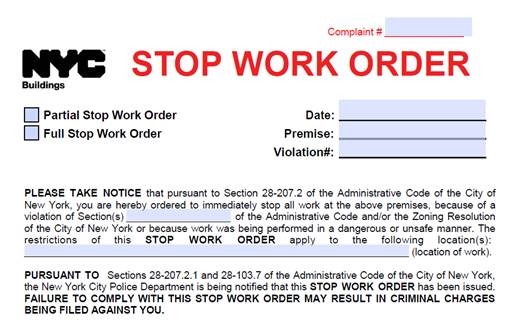
Construction work in New York City must adhere to the Administrative Code or the Zoning Resolution.  If at any point, during the course of construction,  an inspector from the Department of Buildings (DOB) determines that a job site is unsafe, said inspector will issue a Stop Work Order (SWO). 

There are two types of Stop Work Orders that the DOB will issue:  

A full SWO prohibits all work at the site, excluding any work that is needed to make the job site safe. An  SWO can be issued if an inspector is denied access to a site. Furthermore, it can be issued if the proper permits are not in place.

A partial SWO or PSWO prohibits work at a certain area or certain types of work. A PSWO can be issued if work is contrary to approved plans. It can also be issued if the site safety plan or log is missing. 

If the DOB issues a SWO for work without a permit, a permit must be issued. In addition, any associated civil penalties must be paid before work can resume. 

If the DOB comes back to the site and witnesses work going on despite having a SWO, additional violations with hefty penalties may be issued. The first offense for working against a STOP WORK ORDER carries a penalty of $6000 currently.  Subsequent offenses are $12K each. 

To Lift a SWO, you must: 

  • Correct all violating conditions cited in the SWO
  • Provide proof that any associated OATH violations have been resolved
  • Provide proof that all applicable civil penalties have been paid
  • Pass inspection from the unit of the DOB that issued the SWO. Sometimes it will take multiple re-inspection attempts before the SWO is lifted.  

If you have any questions about SWOs or need assistance having one lifted, give S&M Expediting a call. 
Certificate of Opertion

NYC Place of Assembly Permit

What is a Place of Assembly Certificate of Operation and when is one needed?

A NYC Place of Assembly Permit (PA) is a space that allows large groups of people to assemble at a given time for any activity. 

If 75 persons or more are gathered indoors or 200 persons or more are gathered outdoors, a Place of Assembly Certificate of Compliance is needed. 

Assembly places are found in restaurants, theaters, sporting arenas, schools, churches, and auditoriums but can be found in other places as well.

What you need to know.

When applying for a PA, the registered design professional (RDP) is hired to generate the plans. These plans will be filed at the Dept. of Buildings. Those plans will need to address safety issues such as the number of exits and occupant loads. Moreover, handicap accessibility must be provided for PA spaces. The RDP will determine if a sprinkler and/or fire alarm system will be required. Also, seating and furniture arrangement will be shown on the plans. Plans will further show the required travel distances to the exits.

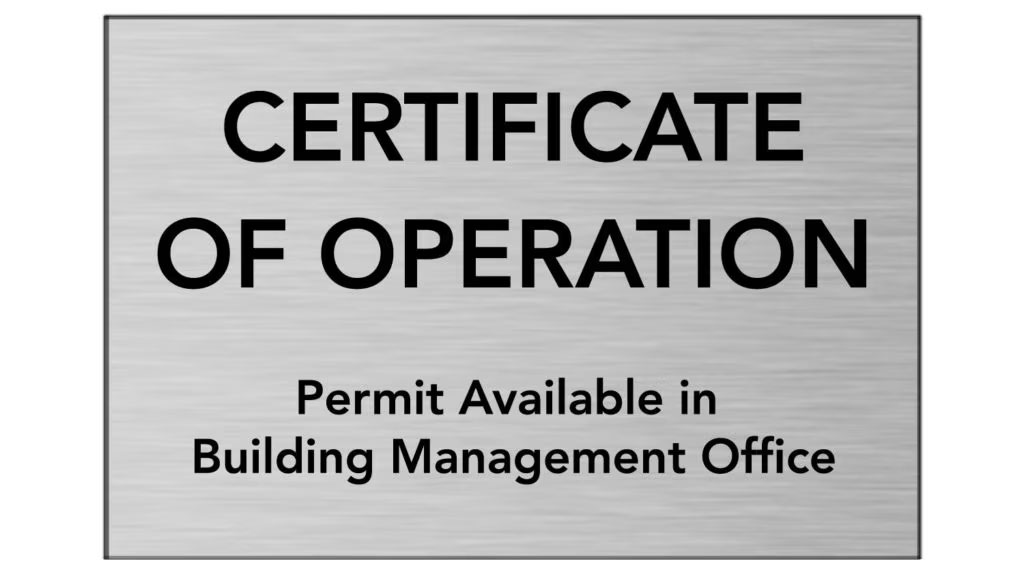
Before the PA space can be legally occupied, the required number capacity sign must be posted. The Certificate of Operation must also be displayed in a conspicuous location within the space. The capacity sign indicates the number of persons that can legally occupy the space.  Approved PA plans must be kept on site for the annual inspection performed by the Fire Department. 

The Department of Buildings issues the Certificate of Operation.   A year after this has been issued, the Fire Dept. will issue a Place of Assembly permit. This will be renewed by the FDNY annually based on the inspection they perform. 

If any of the following changes, an amendment filed at the DOB will be required: 

  • change in establishment name
  • change in seating plan
  • change in use or assembly group. 

Let S & M Expediting help you when planning your place of assembly space.  

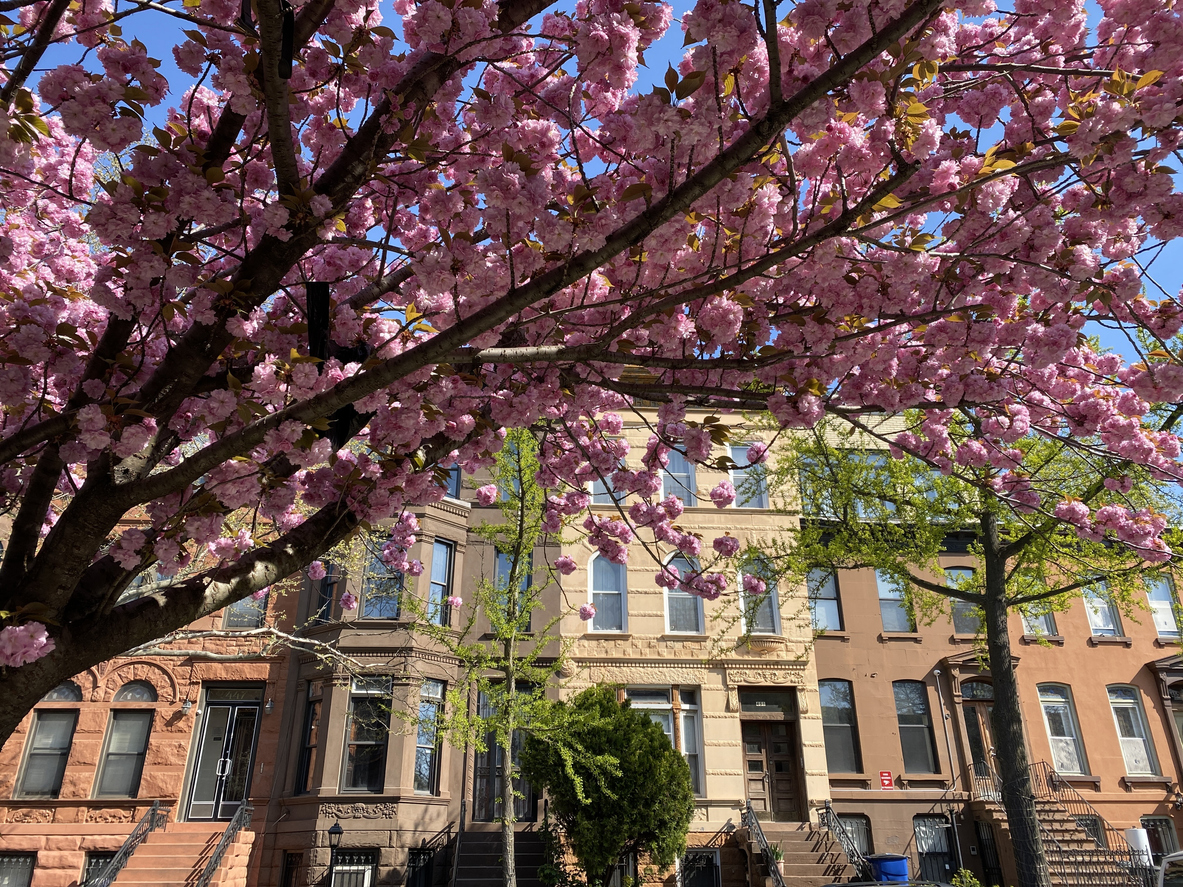
Cherry blossoms and brownstones. - Brooklyn, NY.

TREE PLANTING NYC

In New York City, tree planting is now a requirement because new building and enlargement filings must comply with zoning regulations. For every 25 feet of street frontage, 1 tree must be planted. If your lot has a frontage of 80 feet, you would divide that by 25. This calculation determines the number of trees required. In this example, you’d be required to plant three trees. 

How to comply

Tree planting application is filed with the Dept. of Parks and Recreation. A Registered Design Professional (RDP) will need to generate a site plan referencing the Parks Dept. Plan Review Checklist. The Parks Dept. will review the site plan and plans filed with the Dept. of Buildings (DOB). This is to ensure the protection of existing trees. They check if tree bed sizes are correct before construction is completed. This is all part of the New York City tree planting process. 

For expedited plan review, a Certified Arborist Report must be submitted with your filing. It is important to start your tree filing early in the planning stages. The DOB requires proof of filing with the Parks Dept. before issuing construction permits for New York City tree planting. You only need a receipt from the Parks Dept. stating that the plans have been submitted for review to apply for the DOB permits. However, the Parks receipt is not a permit to do tree work. After the plan exam is complete and Parks approves the plans, those are submitted to the DOB. This submission is for authorization of the Builders Pavement plans. It also proves that the location of the new tree(s) has been approved by Parks. 

Do it the right way

If you need to plant a tree or trees to obtain a Certificate of Occupancy from the DOB, you must comply with the Planting Requirements for New Buildings. If you need to plant a tree but it is not feasible on your lot, you can pay into the Parks Tree Fund to satisfy tree planting requirements. Thus, New York City tree planting can be adapted to your situation.

If you have any questions about tree planting, give S&M Expediting a call. 

Get old permits and filings fixed at the NY Dept of Records

CLOSING OUT OLD PERMITS OR FILINGS

Often when a unit owner or homeowner is about to sell their property, the title search turns up old permits or filings. These were done by previous owners. Such issues can hold up the closing. S&M can help with closing out old permits or filings.

If this has happened to you, don’t despair.  There is a solution. Depending on the age of the filing, and if all permits required for the project were issued back then, you will need to hire a registered architect (RA) or professional engineer (PE). They will assist with reinstating the application.  

When the application for reinstatement has been approved and the reinstatement fee paid, then the close out of the application can commence.  In cases where there was a plumbing permit that was not closed out, a new plumber may be needed. This is necessary if the original plumber is not available.  

For those cases where the filing status shows that not all required permits were issued, the Department of Buildings (DOB) will require that the plans for the project be re-filed.  

S&M Expediting can help with the close out of old filings.  Give us a call. 

NYC Building Permit

WORK WITHOUT PERMIT VIOLATIONS

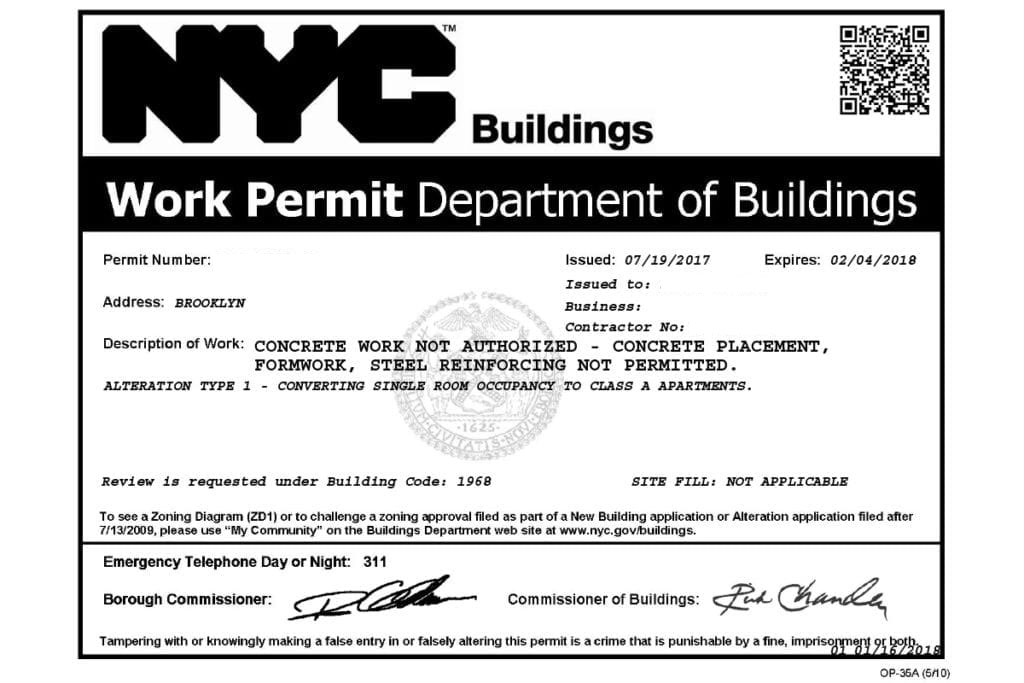
A Department of Buildings (DOB) inspector shows up at your home or place of business and issues a work without a permit violation.  What is your next step?  The first step is to reach out to a reputable permit expediting company like S & M Expediting. They will help assemble the right team you will need to get you out of this jam. 

Work without permits violations are common and unfortunately, costly violations to resolve. If left unresolved, these violations can lead to heavier fines. They can also trigger enforcement actions depending on the severity of the violating condition. 

Clearing a violation for work without a permit

How does one clear a violation for work without a permit?  You do this by taking the necessary steps to obtain a permit.  In some cases, you will have to hire a registered architect (RA) or professional engineer (PE). Their job is to prepare plans to be filed with the DOB.  Once approved, the required civil penalty must be paid. This must happen before the contractor can obtain a permit.  If the violation was for plumbing or electrical work done without a permit, hire a plumber or electrician to obtain a permit. Plans are not required in this case.  Required civil penalty will have to be paid before the permit is issued. 

Civil penalty paid to the DOB is based on the filing fee paid when the job is filed.  Since 2018, the penalty for work without a permit for a one-or two family house is six times the filing fee. The minimum civil penalty is $600.  For all other buildings, the civil penalty is twenty-one times the filing fee.  The minimum penalty is $6000. Meanwhile, the maximum is $15,000. 

You may think that once the civil penalty is paid, the violation is closed out. However, you would be wrong.  If the violation issued was an OATH violation, you’d have to appear at a hearing. In order for the violation to be resolved, you also need to file a Certificate of Correction.  If you are issued a regular DOB violation with no hearing date, an inspection by a DOB inspector is required. This is necessary to have the violation dismissed. 

Reach out to S &M Expediting if you have been issued a violation for work without a permit.  We will help you clear your violation.